Like many musicians from Eastern Bloc countries (in this instance, Ukraine) pianist and composer Vadim Neselovskyi first studied classical music before he and his family moved to Dortmund, Germany. Yet, the pianist had already been turned on to jazz by sailors visiting his home city of Odesa, a port city on the Black Sea. In Germany, Neselovskyi continued his classical studies while working as a jazz musician at night. He moved to the United States to study at the Berklee College of Music where he came into contact with Pat Metheny and Gary Burton. In fact, it was Metheny who produced a promotional recording that featured the pianist alongside bassist Esperanza Spalding and trumpeter Christian Scott aTunde Adjuah. Neselovskyi moved on to the Thelonious Monk Institute (now the Herbie Hancock Institute) in Los Angeles, CA, where he played alongside Mr. Hancock as well as Terence Blanchard, Wayne Shorter, Dee Dee Bridgewater, and many others. He came back to the East Coast to work with his former Professor Gary Burton, appearing on, composing for, and arranging for the vibraphonist band and for recordings.
His new album, "Odesa: A Musical Walk Through a Legendary City" (Sunnyside Records), is a tribute to the city he was born in. Recorded before the current invasion, the music is, nevertheless, filled with passion, with emotions such as joy, anger, defiance, good and bad memories both from Neselovskyi's lifetime and before. Not surprisingly, there's a classical feel to much of this music––in interviews, the pianist mentions being inspired by Russian composer Modest Mussorgsky's "Pictures at an Exhibition", especially in form and focus. Over the course of the 13-song program, this music covers a wide swath of musical territory. What stories this music tells! Whether it's the "Potemkin Stairs" (photo below) or the blooming "Acacia Trees" or playing the "Waltz of Odesa Conservatory" of the memories of "My First Rock Concert", the passion and emotions stand out.
Start "Odesa" at the beginning and don't stop until the final notes of "The Renaissance of Odesa" fade away. Listen in the morning at dawn and, with the birds singing, you could be sitting on those stairs. Vadim Neselovskyi has created a masterpiece and it's not just because of the current war raging in his homeland. In fact, the bulk of the album was recorded in
August of 2020 and finished a year later. While some of the music is elegiac, there are pieces that explode out of the speakers, songs that rock, roar, and dance. "Odesa" is both a celebration of a great city but also the story of Vadim Neselovskyi as he is finding his place in the world. Brilliant music and performance like this should not, must not, be missed.
While studying and living in New York City, German-born pianist/ composer Florian Hoefner had become a busy composer and bandleader. But, his wife got a tenure-track position at a university in Newfoundland and he willingly followed. Eventually, Hoefner also was offered a teaching position and they settled into their new home. The pianist still manages to maintain his Quartet (three albums on Origin Records) and ties with Subtone, a quintet he co-founded while living in Germany; but since moving up North, he organized a trio with two well-established Canadian musicians, bassist Andrew Downing and drummer Nick Fraser. Hoefner made the time to study the rich world of Canadian folk and maritime music to fit into his surroundings as well as to make new musical connections.
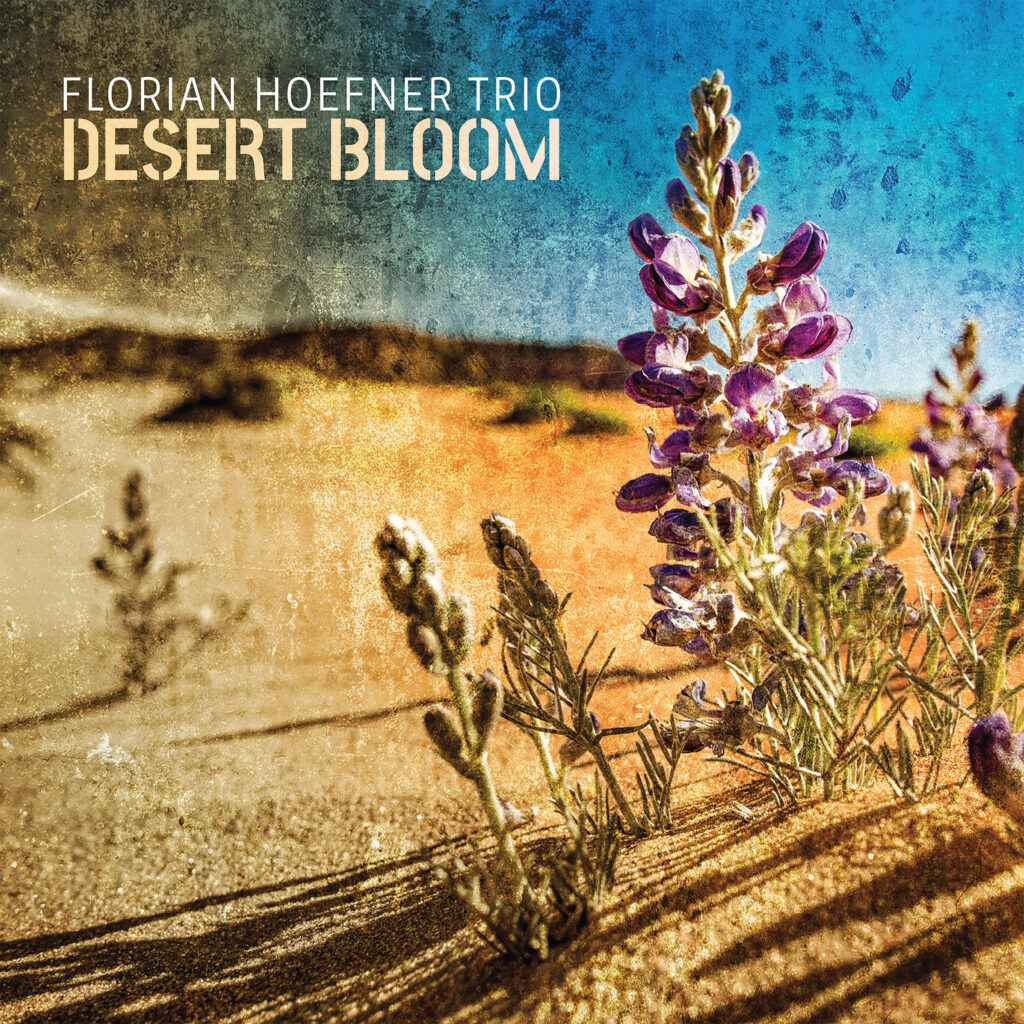
The Canadian trio issued its debut album "First Spring" (Alma Records) in 2019. The pianist's immersion into the folk music of his new community was evident on several tracks––even more evident was how comfortable the trio delving into Hoefner's music and arrangements. The pandemic began in earnest after the trio finished its first full-length tour. The three musicians retreated to their "safe homes" and the lockdown gave the pianist time at home with his young family and more time to read, to listen, and practice. The results of his pandemic hiatus can be heard throughout the Trio's second Alma release "Desert Bloom". Named for the rare occurrence when a desert area gets a lot of rain and the vegetation, which has lain dormant for many years, erupts in all its beauty (see photo below). That's how the pianist felt during COVID with his ensemble projects on hold and teaching relegated to ZOOM. He returned to composing with renewed energy especially after he watched a television program about desert bloom. His thoughts turn to re-creation, reemergence, and new life.
Photo: Martin Bernetti Atacama desert, Chile
The album opens quietly with "Between The Lines"––Downing plays the opening verse supported by the ostinato piano and the swirling cymbals. Hoefner takes the first solo, his bluesy yet expansive lines rising over the powerful bass counterpoint and the driving drums. The title track opens with bowed bass and soft cymbal taps as the leader introduces the theme. Downing's arco solo is richly melodic (his lower notes pull at the heart). When he's done, the pianist the piece into gear, playing a repetitive figure with with the pizzicato bass. The music is filled with interplay, with melodic and rhythmic invention, it pulls the listener in.
Two songs speak to the pandemic experience. The rubato opening of "The Day Everything Stopped" imitates the stasis one felt as the world closed down; that leads to a powerful ballad noted for the splendid ensemble work, a probing bass solo, and the thunderous (even angry) drum spotlight. The piece ends with a return to the main melody which now sounds contemplative. "The End Of the Tunnel" follows––not surprising, the piece has a sense of urgency, of the joy of the possibility of normalcy. There are moments during Downing's solo when the music becomes pensive but that does not last long thanks to the power in Fraser's drumming and the energetic piano.
"Desert Bloom" is often bright, sometimes shy to open up but ultimately a delightful way to spend 65 minutes. The music opens even further as one listens again and again; concentrate on each instrument and then listen again to the collective. There has been a large amount of excellent piano trio music released in the first six months of 2022 and much more to come. This album by the Florian Hoefner Trio is certainly one of the best of this or any year!
Pianist Denny Zeitlin first became interested in synthesizers in the early 1970s and used them extensively in 1978 when created the soundtrack for the first remake of "Invasion of the Body-Snatchers". He has used them now and again over the decades, upgrading his equipment along – in 2013, the good Doctor (he's a practicing psychiatrist) reunited with drummer George Marsh who he has known since joining Zeitlin's Trio in the late 1960s. The percussionist, who moved from the East Coast to the West in 1968, may be best known for his work with mandolinist David Grisman, the Jerry Hahn Brotherhood, Mose Allison, and so many more. He set his drums up in Zeitlin's studio and the duo began to play electric-acoustic acoustic improvisations. In 2015, Sunnyside Records released the duo's first album, "Riding the Moment" followed in 2017 by "Expedition."
"Telepathy" (Sunnyside) is an apt title for their third album. Taken from sessions over a five-year period (pre-Pandemic), the 14-track, 76+ minute, program is an aural funhouse. Zeitlin, who continually upgrades his keyboard setup, blends his grand piano with numerous synths, hardware, and electronic keyboards –– meanwhile, Marsh plays his acoustic drum, adding percussion every now and then. There is no script, no sheet music, and, believe it or not, the vast majority of these tracks are first takes. For those of us who grew up in the 1960s and 70s, you can imagine Zeitlin sitting in the middle of the studio surrounded by his numerous "toys". He easily moves from one to another; listen to the joyful "Highlands", the track that opens the proceedings. It's a funky jig complete with acoustic piano, keyboard bass, various synths and dancing drums. Several minutes in, all but the drums drop out and Zeitlin begins what sounds like a guitar solo (no, it's a keyboard patch).
In the space of one song, one might think he/ she is listening to Chick Corea or Keith Emerson or Joe Zawinul. Zeitlin has his own sound and is always searching. Listen to the duo romp on "Quicksilver" (dig the pianist's left hand in the first minute as well Marsh's delightful brushes work in the next minute. Thunderous drums and rumbling piano chords open "Black Hole" before the music goes in different directions. In the middle of "Moonflower", a "virtual choir" rises out of the rhythm section and it seems so right. "If Only" is an atmospheric ballad-cum-conversation played by synths and drums while "The Ascent" has, at times, a frenzied feel that is alleviated by the hypnotic piano melody in the middle. As the music rolls forward, the pianist moves freely between keyboards that hints at a full breakout but the listener hears a gentle finish. The program closes with a bow to the halcyon days and nights of San Francisco in the 1960s with the hard rocking "Fillmore Dreams" with wailing synth "guitar" and thundering drums as well as a taste of the blues.
It's easy to get totally wrapped up in the many and varied keyboard sounds but do pay attention to Marsh's inventive drum work. Even though the two musicians cannot see each other due to the way the studio is set up, the music never gets "lost" or bogged down in repetition. Because these pieces are improvised, there are many moments the listener feels like he is in the middle of the telepathic action. Yes, "Telepathy" is the correct title for this album but it could easily be called "Great Fun" or "The Sandbox Sessions". Denny Zeitlin and George Marsh keep your attention throughout the album by letting their the minds free to wander the sonic universe. Feeling stress? Put this music on good and loud; your housemate and/or neighbors might complain but you can't help but feel good as the music dances around you.
I have known bassist Joe Fonda for over four decades. He lived in my hometown for a number of years, often played at local venues, produces a yearly show (an Improvisors Forum) with The Buttonwood Tree (Middletown, CT), and has toured the nationally and internationally with so many different artists ranging from Barry Altschul to Anthony Braxton to Billy Bang to Jaimoe (of The Allman Brothers Band) to Michael Musillami to Satoko Fujii. He leads or co-leads a number of ensembles and, before the pandemic, was one of the busiest musicians in the Creative Music world.
Fonda has performed and recorded with pianist Carlo Morena for over three decades producing four albums with either Jeff Hirschfield or George Schuller on drums. under the name Step In Trio (from a 2000 album of the same name). In March of 2019, Fonda and Morena came to Firehouse 12 in New Haven, CT, with drummer Felix Lecaros Herrera as the third member of the trio. The dChilean native also works with saxophonist Eden Bareket and has recorded with guitarist Nicolás Vera. The result of the New Haven gig is "Voila la Tendresse" (Not Two Records). The seven song, 70+ minute, program is filled with intuitive playing and intelligent interplay, emotional depth, and really fine compositions (all but one by the pianist). Because Morena and Fonda have such a long and rich history plus they entrust Herrera with being the foundation each song, this Trio sounds anything but "typical".
The title track opens the album on a lyrical note, the piano melody pushed forward by the dynamic drumming and bass counterpoint. The bassist gets the first solo, a delightful statement that is both lyrical and percussive supported by the driving drums and piano. There is a touch of dissonance at the onset of Morena's long solo – there is such power and excitement as the Trio ramps up the intensity (at times like Keith Jarrett's work with Gary Peacock and Paul Motian). About 10 minutes in, Morena's left hand drops into a modified "boogie-woogie"; Fonda and Herrera follow happily and the groove is irrepressible right to the final seconds (Morena tosses in a few choice Thelonious Monk quotes in the final moments).
Photo: Guido Nardi
Fonda opens "Japan" with a long solo that gain blends lyrical and percussive with a hypnotic feel at times. Four+ minutes in, the pianist and drummer enter pushing the music into a Bill Evans-style atmosphere with a gentle stop & start in the rhythm; yet, notice how the music moves into a different area more related to the rhythmic pulses of the piece than an Evans improvisation. Rumbling piano and bluesy bass licks introduce "Dog With No Name", tune that moves from Gershwin-style flourishes to raucous blues to bass solos short and long. a swinging piano romp that gets a bit off-center by the powerful drumming. The one non-original is "I Love Music" composed in 1974 by Emil Boyd – it's a sweet solo piano piece that carrie a lot of emotion.
The program comes to its close with "Chorale", a piece that builds slowly from the piano-bass-brushes opening into a powerful piano solo that pushes the rhythm, especially Lecaros Herrera (pictured) to lock in with Morena for a thunderous climax. Still, it's the pianist who puts the song and the album to bed with a short series of light-fingered descending lines.
Step In – Carlo Morena, Joe Fonda, and Felix Lecaros Herrera – have produced an excellent alum in "Voila la Tendresse". The music engages the Trio which, in turn, captivates the audience. Powerful, lyrical, rhythmic, emotional music that deserves your close attention – highly recommended!
I usually use this space on Thanksgiving Day to write about the state of the world and how music can help us through hard times, giving us hope for a better world. This year, I am going to forgo my editorializing––chances are good you're talking about the world at your dinner table and/or on ZOOM calls with the family. You don't need me to go through that. I just wish you the best and hope that this is a time of good health and quiet reflection.
In the meantime, this month brings a number of fascinating "historical" albums, some with music not released before by Sonny Rollins, Bill Evans Trio 1968, and Wolfgang Lackerschmid/ Chet Baker Quintet with Larry Coryell, Buster Williams, and Tony Williams––let us take a look.
Not surprisingly, there are two new releases from those inquisitive and quite thorough folks at Resonance Records (both vinyl packages will be available on Record Store Day/ Black Friday November 27). The story behind "Sonny Rollins: Rollins In Holland" is smartly recounted in the 100-page booklet included in the two-CD and three-Lp Vinyl packages which include interviews with the three musicians who create the musical magic. There are great interviews with the person who uncovered the Dutch radio recordings that are the first four tracks on the program. There are also two tracks from a gig at the Go-Go Club in Loosdrecht in The Netherlands on May 5, 1967 (the same day that the radio program was recorded at lunch time). The largest chunk of playing time belongs to five tracks recorded two days earlier in Arnheim, The Netherlands.
Mr. Rollins is in fine form throughout although he seems reined on the 30-minute radio program. He gives equal time to his rhythm section––bassist Ruud Jacobs and drummer Han Bennink––none of the four tracks are longer than seven minutes. Both of the sidemen were considered the finest players on their instruments in the country and were thrilled to be working with the saxophone legend. Bennink, 25 years old at the time, had already joined the Instant Composers Pool but had absorbed the playing of Kenny Clarke and Max Roach before falling under the spell of Sunny Murray. The drummer, along with the 29-year old Jacobs, had worked together as a unit numerous backing American musicians such as Wes Montgomery, Johnny Griffin, and Ben Webster. Both loved the records that Mr. Rollins had made in the 1950s, especially the trio sessions for Blue Note and Riverside Records.
Photo courtesy of Michael Maggid
Fans of this recordings, especially "Freedom Suite" and "Live at The Village Vanguard", will love the Arnheim tracks. The sound under headphones is quite good (kudos go to label head George Klabin and Fran Gala for their splendid sound restoration) as you can really hear riding the powerful work on the rhythm section on pieces such as "Four" and "Three Little Words". There are moments where the sound fades but the trio never does. Mr. Rollins, two months away from losing his good friend John Coltrane and a year away from a six-year recording sabbatical, sounds as if he's having great fun, especially on the live cuts. Jacobs, whose 29th birthday fell on the first day of recording, and Bennink plays with abandon, which is just what Dr. Rollins hoped for. .
There have been bootleg recordings from these live dates circulating around the world for over five decades. Zev Feldman and Resonance Records have put together a splendid package with plenty of photographs from the days was in The Netherlands plus the interviews are a true pleasure to read. And, much of this music is sublime. "Live In Holland" adds yet another shining example of how great Sonny Rollins sounds in concert––have fun counting all the quotes from other songs he throws in, especially in the last 10 minutes of "Four".
Up until 2016, the only recorded instance of the Bill Evans Trio with Eddie Gomez (bass) and Jack DeJohnette (drums) was the GRAMMY Award-winning Verve Lp "Bill Evans at the Montreux Jazz Festival." Four years ago, Resonance Records released "Some Other Time: The Lost Session from the Black Forest", a studio album the Trio recorded the same week as their Montreux Festival appearance. One year later, the label released "Another Time: The Hilversum Concert", a live concert recorded in the studios of the Netherlands Radio Union (NRU) a week after Montreux. Both albums showed the Trio at the height of their creative abilities. The group then spent a month in residence at Ronnie Scott's in London. DeJohnette told Zev Feldman at Resonance Records he had recordings he had made at the time but the sound was fair at best. Feldman initially passed on the tapes, hoping to find other enthusiasts who may have taped a show or two.
The story of how the drummer and the label executive discovered a glitch in the playback, fixed it, and the magic of the music was revealed is told in the 44-page booklet that accompanies "Bill Evans: Live at Ronnie Scott's". The 2-CD, 2-Lp, arrives just in time for Record Store Day November 27 and if this 20-song program (in the form of two sets) doesn't warm your tired bones, nothing will. The band sounds so together, so relaxed, and so ready to stretch out that their musicality shines through. There are few surprises in the choice of repertoire but pieces such as "Alfie", "Waltz for Debby", the two versions of "Emily" (from the pen of Johnny Mandel), "Someday My Prince Will Come", and "'Round Midnight" sparkle with delightful solos and interactions, smart harmonies and delicate musicianship. The one rarity is "For Heaven's Sake", a song composed by Don Meyers, Elise Bretton and Sherman Edwards for the Claude Thornhill Orchestra in 1948 but made famous by Billie Holiday in 1958 on her "Lady In Satin" album (the last released in her lifetime). Evans first recorded the piece on "Evans 64" with bassist Gary Peacock and drummer Paul Motian and once again in December 1968 at The Village Vanguard with DeJohnette's replacement Marty Morell (released on "The Secret Sessions 1966-1975" assembled from tapes recorded without permission by Evans super-fan Mike Harris.
To my ears, "Live at Ronnie Scott's" is the best representation of the creative work of bassist Eddie Gomez of the now-four albums from this Trio. His amazing melodic sense stands out and you can really hear how he inspires the pianist and drummer. Yes, I know that there seems to be several thousand Bill Evans albums on the market but you do not need to be a completist to enjoy "Bill Evans: Live at Ronnie Scott's"; you need to love music that is emotional and melodically rich with many moments of rhythmic swing. Thanks go to Jack DeJohnette for preserving the tapes and Resonance Records for persevering to bring this splendid music to light!
Here's the mini-documentary from Resonance featuring Zev Feldman, Brian Priestley, Jack DeJohnette (interviewed by Chick Corea), and Chevy Chase:
Photo: Hans Kumpf
Vibraphonist Wolfgang Lackerschmid and trumpeter/ vocalist Chet Baker first began playing in the late 1970s. They recorded a duo album for the vibraphonist's own Sandra label and, in the aftermath, Baker invited Lackerschmid to be a member of the trumpeter's touring group. Guitarist Larry Coryell saw the duo play at a Festival in Austria (where Coryell was playing with saxophonist Sonny Rollins) and suggested they play together. Baker's agent liked the idea and floated the idea of adding a rhythm section which turned out to be the brothers in name only, bassist Buster Williams and drummer Tony Williams.
The five musicians went into a Stuttgart, Germany, studio and created "Quintet Sessions 1979" to be released on Sandra. Thanks to D.O.T. Time Records, the album has a new life in the 21st Century. The six pieces (the seventh and eighth tracks are a rehearsal and the other an alternate take) include two composed by the guitarist, one each from the Williamses and Lackersachmid plus a lovely take of Jimmy Van Heusen's "Here's That Rainy Day." Everyone respects Baker's limited technique; still he rises to the occasion throughout with a handsome tone and his fine sense of melody. He only sings on one track, a sweet wordless vocal on Lackerschmid's "Balzwaltz" (but not on the alternate take). Bassist Williams stands out in the mix, his melodic solos and intelligent counterpoint meshes well with the rest of the group. Listen to how the bassist wraps his thick notes around the lighter trumpet tones without overwhelming Baker.
The quintet creates a pleasing swing on Buster William's "Toku Do" with solid solos from Baker, Coryell (who is a stalwart throughout the program), the composer, and strong work from the drum set. There's a funky feel to the opening of Tony Williams's "Mr. Biko" which then drops into a loping swing. The drummer rarely lets loose but his cymbal work is delightful. The Caribbean/ French feel of the guitarist's "Rue Gregoire Du Tour" shows the influence of Burt Bacharach; one half-expects Dionne Warwick to step out and vocalize. Instead, we get melodic solos from Baker, the composer (his trademark blazing solos replaced by a fine melodic sense), Lackerschmid, and the bassist.
"Wolfgang Lackerschmid/ Chet Baker: Quintet Sessions 1979" sounds a bit undercooked at times––perhaps it's the addition of two extra tracks that helps to create that illusion. Yet, there is enough good playing on this album, especially from Buster Williams and Larry Coryell, to recommend that you give it a listen. You can do just that by going to https://dottimerecords.bandcamp.com/album/quintet-sessions-1979 where you can also get more information and purchase the recording.
Pianist and composer Matthew Shipp turns 60 years old in early December and remains one of the busiest, most creative musicians on the Black Music scene. His current Trio––bassist Michael Bisio and Newman Taylor Baker––is, arguably, his finest ensemble while his music continues to expand. The band's new album, "The Unidentifiable" (ESP Disk), captures one's ears and mind from the opening seconds of "Blue Transport System" and refuses to let go until the 10:31 "New Heaven and New Earth" fades to silence. Even then, moments return in snatches of melody, sounds, and beats. Upon first listening, you might think Newman Taylor Baker's splendid drumming is the reason to return. Perhaps it's Michael Bisio's powerful and often melodic bass work or the muscular piano, long flowing phrases, or thoughtful compositions that the leader supplies that turn your head. In fact, it's all three and more.
Photo Mark Lazarski
I've learned to listen to a new Matthew Shipp Trio all the way through each time. This is not music you "cherry-pick" your favorites and ignore the rest. Listen to how the rhythm section goes its own way on "Phantom Journey" or provides a gentle cushion of colors for the exploring piano lines on "Dark Sea Negative Charge". Baker's trance-like drums go alone on the short "Virgin Psych Space 1" serving as an intro to the trio's reading of "...Space 2". Note how each music builds on those drums, Bisio's bass weaving in and around while Shipp's piano travels above.
There is a quiet passion pulsing on the above-mentioned "Dark Sea...."; check out the fascinating hard drumming on "Trance Frame" (another short solo piece) and the powerful piano on "Phantom Journey." The sound of the album, engineered by Jim Clouse in Park West Studios in Brooklyn, NY, is clean and loud. Te lengthy final track will glue you to the chair, the thick bass tine, dancing snare work, and the ever-exploratory piano lines slowly build to a powerful climax–Bisio's bowed bass and overtones atop Shipp's gently piano melody become a contrast in light and darkness dropping out so the music can close on Baker's subtle brushwork.
"The Unidentifiable" is one more high point in the creative career of Matthew Shipp, not just for the music he composed for the Trio but also for his continued dialogue with Michael Bisio and Newman Taylor Baker. There is no compromise, no cliches, just a powerful message of creativity in uncertain times.
Pianist and composer Lafayette Gilchrist has created an amazing amount of music, relevant music, over the past three decades. A resident of Baltimore, MD, since 1987, his music covers a wide swath of territory, from House to Jazz to Hip Hop to Funk to Blues and beyond. His music has been featured on the HBO series "The Wire" "Treme", and "The Deuce", he's played with the David Murray Quartet as well as drummer Louis Moholo-Moholo, and bassist William Parker. The pianist gets compared to many keyboard masters, from McCoy Tyner to Willie :The Lion" Smith––his ability to play so any styles reminds this listener of the late Jaki Byard.
It's been 13 years and myriad experiences since his last Trio album ("3") was issued. "Now" (self-released) has arrived and it's an collection of amazing adventures. Two CDs, 16 songs (all originals), 150 minutes, and the great rhythm section of Herman Burnie (bass) and Eric Kennedy (drums), the music is an incredible journey. Opening with "Assume The Position" (first heard on David Simon's "The Wire"), the listener is bowled over by the thundering chords, the rapid-fire drums, and the pounding bass. Latter on Disk one, "BMore Careful" is a New Orleans-inspired blues that serves a warning and a spotlight for Burnie's handsome arco work. Kennedy's drums and Gilchrist's piano are mixed high and loud making the music jump from the speakers.
Dig into "On Your Belly Like a Snake", another hard-edged romp. Most of the longer pieces (seven of the 16 tracks are 10 minutes or longer) usually have stretches where the band eases off the intensity but here it's a short break before the drums push the leader to play harder. Disk one closes with "The Midnight Step Rag", a delightful dance with a touch of the Crescent City in Kennedy's drumming and a bouncy piano solo. You can just about pick out the deep notes of the bass but also listen to the pianist's active left hand.
Photo: Theresa Keil
Disk two opens with the 13:33 "Tomorrow Is Waiting Now (Sharon's Song)", a handsome medium tempo ballad that builds in intensity on the strength of Gilchrist's splendid piano playing. Burnie creates a fine solo as well and even though Kennedy does not solo, he plays an integral role throughout the piece. The following piece, "The Wonder of Being Here", is a true ballad, a handsome one at that. The bassist shows his melodic side, especially beneath the lovely piano solo. Later on the disk, "Can You Speak My Language" is a poignant ballad, the two-handed piano playing and Gilchrist's melodic runs seem to nod towards Keith Jarrett.
Disk two and the album closes with "Specials Revealed", a rich melody wrapped in a soulful rhythm. Gilchrist's solo is built off the repeating chords in his left hand and he gracefully moves up the keyboard while Burnie hugs the bass line and Kennedy pushes the rhythm forward. I understand the title of the song is also the name the leader has given the Trio–that make sense as this is special music. Yes, "Now" is a lot of music to take in all at once, really three good sets of music on two CDs. But, take your time and do take it all in. One can hear so much in the music that Lafayette Gilchrist, Herman Burnie, and Eric Kennedy have created for this album. Gilchrist's collection of songs plumb his own experiences as well as those of his community, reminding us that music not only tells stories but moves us emotionally. "Now" moves, oh yes it moves!
The trio of Geof Bradfield (tenor and soprano saxophones), Ben Goldberg (clarinet and contra-alto clarinet), and Dana Hall (drums, percussion) first met in 2017 at The Hyde Park Jazz Festival in Chicago, IL. That chance encounter led to "General Semantics" (Delmark Records), recorded a year later. All three musicians have years of experiences behind them as leaders, co-leaders, or group members (Bradfield and Hall have worked together over two decades)––one can tell from the music that recorded how comfortable they are with each other, willing to push and be pushed into many different musical areas.
What a splendid sonic journey this is. Opening with the quiet rush of "Air" (Bradfield on tenor, Goldberg on contra alto, and Hall using brushes), the music dances forward delightfully as the two reed players carry on quite a conversation. Composed by the late pianist Cecil Taylor and recorded in 1961 by Steve Lacy, the "swinging" track has a timeless feel. "Tioga Street Zenith" is a three-way conversation, a bit more frenzied yet Hall sticks with brushes as the reeds spar and parry. "Last Important Heartbreak of the Year" may sound like the title of a Country ballad but is really a rollicking tune with New Orleans drumming goosing the reeds right along. A bit later in the program, "Hit Flip Switch" (from Goldberg's prolific pen) also is a delightful romp, hearkening back to the raucous music of Louis Armstrong and Johnny Dodds. Bradfield's laughing soprano and Goldberg's playful clarinet should tickle one's fancy!
The soprano sax and clarinet combo returns to dance together yet again on Hermeto Pascoal's happy "8 de Agosto"––again, the two reeds weave around each other as Hall kicks and sticks away with glee. Bradfield's tenor sax introduces the title song which soon drops into a funky beat, Goldberg's contra alto clarinet producing the bass line. The tenor solo is built off that bass line while Hall keeps the tune close to the ground. "Half The Fun" opens with a "deep" solo from Goldberg over quiet hand-held percussion. Several minutes later, Hall drops into a modified "jungle" rhythm a la 1920's Duke Ellington, Goldberg plays a slinky bass line, and Bradfield creates a sweet soprano sax melody.
The album comes to a close with "Under and Over" which has a "freer" feel as the tenor sax and drums open the piece in a fiery conversation. After they stop, Hall drops into a slow, bluesy, beat, Goldberg's clarinet gets the melody while Bradfield acts as the bass line. There's a feel of Julius Hemphill's "Hard Blues" in the sound of the music, in the way the sax and clarinet move together. The piece closes with a classically-inspired clarinet and tenor saxophone duet.
The trio of Geof Bradfield, Ben Goldberg, and Dana Hall reminds us that when like-minded musicians get together, magic can happen. Magic does happen on "General Semantics"––this delightful and musical recording is well worth your attention!

 Posts