The John Hollenbeck Large Ensemble played last night 2/18) in the Buckley Recital Hall at Amherst College - thank heavens the ceiling is so high for the energy of this group might have brought the roof down. 18 musicians (including vocalist Theo Bleckmann) plus conductor JC Sanford brought Hollenbeck's complex music and arrangements (a lovely take on Jimmy Webb's "Wichita Lineman" was the only non-original) to life. The front line featured 5 reed players - Chris Speed, Jeremy Viner, Ben Kono, Dan Willis and Bohdan Hilash - all of whom played multiple instruments. Behind them, the trombones of Mike Christenson, Jacob Garchik, Rob Hudson and Alan Ferber gave the music depth while the trumpets of Dave Ballou, Tony Kadleck, Jon Owens and Laurie Frink provided power and, at times, a fascinating palette of swirling colors. Bassist Kermit Driscoll (electric and acoustic) served as timekeeper and also played melodic counterpoint - his flying finger work on "Perseverance" was mighty impressive. Patricia Franceshy played vibraphone, marimba and other percussion while pianist Red Wierenga made his debut with the JHLE (and is joining the Claudia Quintet for its upcoming tour).
What stands out for this listener is how the compositions are so well-drawn, how the soloists work within the composer's challenging frameworks, how Bleckmann's voice (and sonic manipulations) rise above the ensemble often serving as an adjunct member of the reed section and, most of all, the conversations within the songs. No trumpet solos last night; still, the 4 trumpets were an integral part of each piece. Often, the "bottom" of the music belong to the trombones and Hilash's bass clarinet. The juxtaposition of Ben Kono's flute with the tenor work of Speed, clarinet of Viner, and soprano sax or English horn of Willis intrigued and pleased - there were several sections during which Bleckmann and Kono sang/played the same melody line. Wierenga's piano work was inaudible during the louder moments but, on the quieter pieces, was the important foundation and melodic voice. As for the leader, he is more than the "pulse" of the band, often involved in the musical dialogues as another voice, sometimes as the transition between sections, never overplaying.
As wonderful as this music is on CD, the pieces take on new life in person. Following the music as it moves through its various sections, as conductor Sanford cues the band or stands back for solos (he even crouched as Willis and Speed roared back and forth at each other, and as Bleckmann beautifully sang the words to "An Irish Blessing", the listener loses track of time and place. Music should transport us; often, it beats us down with volume or tricks us with insincerity. The John Hollenbeck Large Ensemble raised questions, pushed hard against any expectations, made me laugh, and touched my soul. Considering the size of the ensemble and the availability of the musicians (incredibly, 10 of the 18 musicians on stage were on the JHLE's 2005 debut CD), the group does not do many live shows. If you see a listing for them, do not hesitate to obtain tickets. For more information, go to www.johnhollenbeck.com.
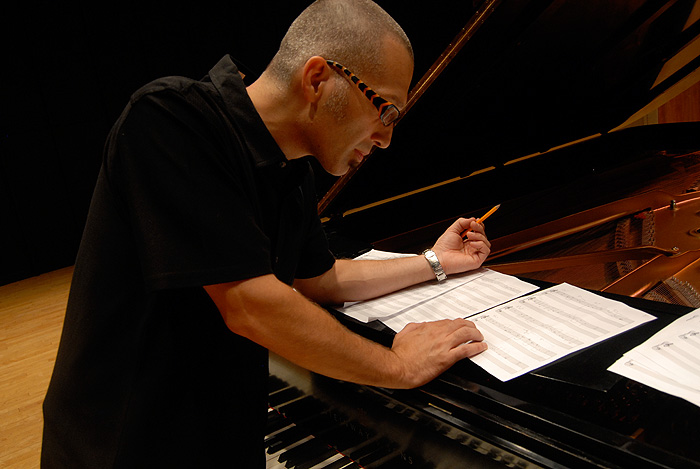
Had the opportunity to meet and chat briefly with Earl MacDonald, composer, arranger, and currently Associate Professor and Director of Jazz Studies at the University of Connecticut. He's a very busy person yet finds time to write a highly informative blog. Check him out at earlmacdonald.com and find his fine blog at everupandonward.blogspot.com/.
Professor MacDonald is one of an excellent cadre of music educators who live and work in Connecticut. Western Connecticut State University has Jamie Begian, Southern Connecticut State University has David Chevan, Wesleyan University has Anthony Braxton and Jay Hoggard plus Noah Baerman while Yale has many fine classical and jazz people. Hartt School of Music, Connecticut College, Trinity, most, if not all, of these schools have impressive faculty.
Showing posts with label concert review. Show all posts
Sunday, February 19, 2012
Saturday, December 10, 2011
O Canada Day!
Had the great joy of seeing and hearing Canada Day, the quintet led by drummer-composer Harris Eisenstadt, at Firehouse 12 earlier tonight. I have the pleasure of attending a number of concerts at the New Haven venue, listened to a slew of excellent musicians, and the 2 sets I heard from this group were among the most consistent and original that i can recall. (In my notebook, I renamed them "4 Beards and Matt Bauder" - with the addition of bassist Garth Stevenson, only the saxophonist is clean-shaven. The leader, the bassist, trumpeter Nate Wooley and vibraphonist Chris Dingman all have beards - I digress.)
The 2 CDs the band has released, the first on Clean Feed and the second on Songlines, are quite good but, in person, the band really shines. Eisenstadt arranges the pieces so that there are concise sections of thematic development, often with the main theme shared among the musicians on the front line. There are phrases played behind many of the solos, sometimes tempos shift, voices drop out; the textures are rich and varied, the rhythms often thrilling and the band shows great sensitivity in the quieter moments. Wooley's solos are often rough-edged yet he also has a softer side. Bauder's notes in the higher ranges of his tenor saxophone had sweetness yet he, too, had fiery moments. Dingman's vibes added color, sustained chords and phrases that ranged from clean, single-note runs to distorted textures. Stevenson, a new name to me, played with great authority - his "bow" work was rich as well as rhythmical. Through it all, Eisenstadt created wonderful torrents of percussion, egging on the band slamming on the 4/4, and keeping the tempos alive and lively (his brush was just as impressive.) But, to my ears, the best part of Canada Day's music is that every song sounded fresh and original - I could not pick out any obvious influences. I'm sure the drummer might point some out but I just sat back and soaked it all in.
I recommend you go to www.harriseisenstadt.com and find out when the quintet is playing in a venue near you. If you love music that will surprise you with its wit, intelligence, strength and rhythmic variety, go celebrate the work and play Canada Day (and not just on July 1 - look it up.)
The 2 CDs the band has released, the first on Clean Feed and the second on Songlines, are quite good but, in person, the band really shines. Eisenstadt arranges the pieces so that there are concise sections of thematic development, often with the main theme shared among the musicians on the front line. There are phrases played behind many of the solos, sometimes tempos shift, voices drop out; the textures are rich and varied, the rhythms often thrilling and the band shows great sensitivity in the quieter moments. Wooley's solos are often rough-edged yet he also has a softer side. Bauder's notes in the higher ranges of his tenor saxophone had sweetness yet he, too, had fiery moments. Dingman's vibes added color, sustained chords and phrases that ranged from clean, single-note runs to distorted textures. Stevenson, a new name to me, played with great authority - his "bow" work was rich as well as rhythmical. Through it all, Eisenstadt created wonderful torrents of percussion, egging on the band slamming on the 4/4, and keeping the tempos alive and lively (his brush was just as impressive.) But, to my ears, the best part of Canada Day's music is that every song sounded fresh and original - I could not pick out any obvious influences. I'm sure the drummer might point some out but I just sat back and soaked it all in.
I recommend you go to www.harriseisenstadt.com and find out when the quintet is playing in a venue near you. If you love music that will surprise you with its wit, intelligence, strength and rhythmic variety, go celebrate the work and play Canada Day (and not just on July 1 - look it up.)
Saturday, April 10, 2010
Happy Whistlings, Indeed! In Fact!
Myra Melford's creativity rarely, if ever, sits still. Over the course of 2+ decades, she has created music for small and large ensembles as well as played with many great musicians, from bassist Mark Dresser to reed master Joseph Jarman to violinist Leroy Jenkins to saxophonist Marty Ehrlich.
Since the first of this year, Melford has issued one of her finest CDs, "The Whole Tree Gone" (Firehouse 12 Records) and appeared on the impressive "Boom Tic Boom", drummer/composer Allison Miller's new CD on Fire Haven.
On Friday April 9, she was in New Haven, CT, to record her newest project, "Happy Whistlings" in the lovely Firehouse 12 studios - she stayed that evening to play 2 sets in the recording studio's fine performance venue. The suite, influenced by "The Memory of Fire" trilogy of Uraguyan novelist Eduardo Galeano, featured the composer on piano, prepared piano and melodica along with Taylor Ho Bynum (cornets, vocal, whistling), Mark Halvorson (guitar, effects) and Stomu Takeishi (electric bass, electronics.) The quartet played the piece twice, once each set. The longer first set featured more noise, ranging from Takeishi using various objects to dampen his bass strings to the various mutes and devices of Bynum to Halvorson's Derek Bailey-influenced guitar shredding. There were long patches of melodic beauty, hypnotic piano phrases colored by Bynum's quiet background riffs. Other moments featured noisy give-and-takes, the cornet sputtering and buzzing while the guitarist scrabbled and scrambled sound, the bassist strummed furiously and the pianist scraped the strings on the inside of the piano.
The second set featured a condensed reading of the piece yet no less interesting. One could hear the influence of the blues on the composer's writing, there was less noisy intensity and a bit more interaction. The lovely melodic fragments stood out more, the quiet spoken word section clearer, and still the piece had great power. Perhaps, for those who had seen and heard the first set, the element of surprise had lessened but, to these ears, the overall shape of the piece seemed sharper.
It will be a while before the recording session sees the light of day but the memories of the live performance only serve to heighten the anticipation to hear this suite again and once more get lost in its intricate construction. Myra Melford continues her personal journey and the curious listener is better for her travels.
Since the first of this year, Melford has issued one of her finest CDs, "The Whole Tree Gone" (Firehouse 12 Records) and appeared on the impressive "Boom Tic Boom", drummer/composer Allison Miller's new CD on Fire Haven.
On Friday April 9, she was in New Haven, CT, to record her newest project, "Happy Whistlings" in the lovely Firehouse 12 studios - she stayed that evening to play 2 sets in the recording studio's fine performance venue. The suite, influenced by "The Memory of Fire" trilogy of Uraguyan novelist Eduardo Galeano, featured the composer on piano, prepared piano and melodica along with Taylor Ho Bynum (cornets, vocal, whistling), Mark Halvorson (guitar, effects) and Stomu Takeishi (electric bass, electronics.) The quartet played the piece twice, once each set. The longer first set featured more noise, ranging from Takeishi using various objects to dampen his bass strings to the various mutes and devices of Bynum to Halvorson's Derek Bailey-influenced guitar shredding. There were long patches of melodic beauty, hypnotic piano phrases colored by Bynum's quiet background riffs. Other moments featured noisy give-and-takes, the cornet sputtering and buzzing while the guitarist scrabbled and scrambled sound, the bassist strummed furiously and the pianist scraped the strings on the inside of the piano.
The second set featured a condensed reading of the piece yet no less interesting. One could hear the influence of the blues on the composer's writing, there was less noisy intensity and a bit more interaction. The lovely melodic fragments stood out more, the quiet spoken word section clearer, and still the piece had great power. Perhaps, for those who had seen and heard the first set, the element of surprise had lessened but, to these ears, the overall shape of the piece seemed sharper.
It will be a while before the recording session sees the light of day but the memories of the live performance only serve to heighten the anticipation to hear this suite again and once more get lost in its intricate construction. Myra Melford continues her personal journey and the curious listener is better for her travels.
Subscribe to:
Posts (Atom)