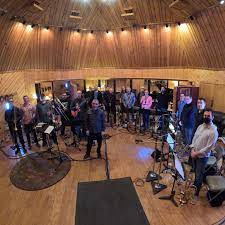
Brazilian native (Sao Paulo), saxophonist, composer, and arranger Felipe Salles came to the United States in 1995. Since then, he has worked with and led several different-sized ensembles and has taught at the University of Massachusetts/ Amherst for 13 years. As a composer, he's been quite interested in the Immigrant experience in the United States––in 2020, Tapestry Records issued "The New Immigrant Experience", his second album with his large band, the Interconnections Ensemble (their 2018 release, "The Lullabye Project", was based around tunes from the composer's Brazilian upbringing). The "...Immigrant Experience" is a multi-media project that combines Salles's powerful compositions with interviews featuring immigrants to the US as part of DACA (Deferred Action for Childhood Arrivals). The stories within the music are heart-breaking, emotional, stunning, and question the attitudes of politicians around the country who hold the future of these people hostage.
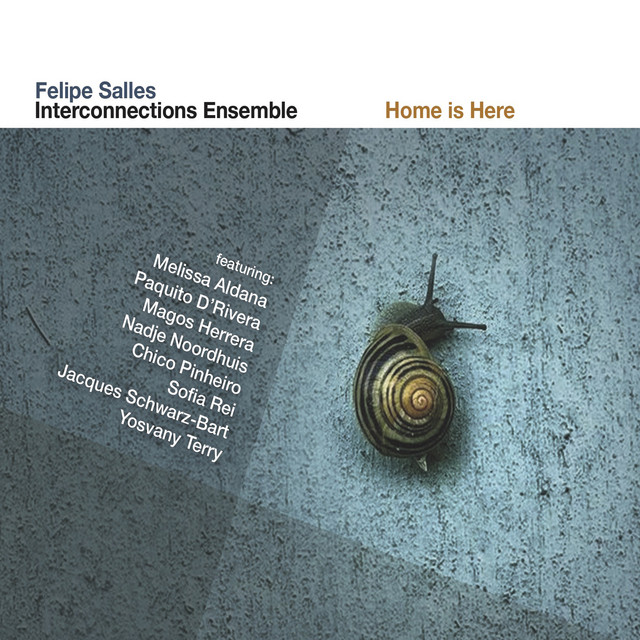
The 19-member Ensemble's latest project is "Home is Here" (Tapestry Records) and finds Salles writing intricate and vibrant pieces for eight guest artists, all of whom left their countries of origin to pursue their artistic dreams in the US. The album opens with "Re-Invention", a vehicle for Paquito D'Rivera, the oldest guest in the project who, arguably, had the hardest journey to citizenship. Listen below to how Salles blends Cuban rhythms into the body of the piece plus uses the ensemble to paint an evocative portrait. Rivera's joyous clarinet solo (like most if not all of his solos) dances with glee through the musical landscape. "World Citizen" finds Terry, the other Cuban ex-pat, in a less formal setting, one in which the drums and percussion push the proceedings forward. The sensuous feel gives the soloists (bass trombonist Angel Subero and alto saxophonist Terry) just the right cushion (the setting for the sax solo has more fire but is positively effective).
The two tracks with vocals are quite different. Ms. Rei's moves easily through "Meridian 63", the mid-tempo "bouncing rhythm" supporting her voice as do the brass on the verse. Jonathan Ball's rollicking soprano sax gives the vocalist to scat along with the reeds and brass. Quiet flutes lead the group in on "Two Worlds Together", a "dark" ballad featuring Ms. Herrera. Note how Salles uses the sections to provide a gentle response to the huskiness of the wordless vocal. However, the emotion displayed by Ms. Herrera gives Tyler Burchfield's bass clarinet solo its focal point while freeing up the vibraphone playing of Luke Glavanovits.
"Home is Here" comes to a close with "Storytelling". After a quiet opening, the rhythm section propels the piece forward with tenor saxophonist Melissa Aldana leading the ensemble through the theme. At the close of guitaristKevin Grudeki's solo, the ensemble drops out and Ms. Aldana steps out for a short, lovely, solo. She then leads the band back in to support her soaring and exuberant solo. The full-throated music reminds the listener that many musicians from other parts of the world, including Felipe Salles, have made their mark in this "Promised Land" thankful for the artistic freedom that the United States provides, finding their voice in the Creative Music. We listeners are thankful for the many sounds these artists have brought to our lives.
Art Hirahara is an impressive pianist for many reasons, especially for his love for melody and harmony as well as his ability to play many different styles of music. Not just "play" but his innate ability to fit his creativity into the work of so many artists. He has played with the fiery baritone saxophonist Fred Ho, with drummer and conceptualist royal hartigan (in his quartet Blood Drum Spirit), been musical director for several vocalists, recorded with drummer Akira Tana, and saxophonists Don Braden plus Tom Tallitsch (and many more). He's released five albums as a leader with the most recent four appearing on Posi-Tone Records –– Hirahara has also played on numerous albums for the label as a member of collective ensembles organized by label owner Marc Free and other artists albums.
"Balance Point" (Posi-Tone) is the pianist's sixth album and features him on solo piano (two tracks), in trio settings with Joe Martin (bass) and Rudy Royston (drums) plus five tracks with tenor saxophonist Melissa Aldana. All but one of the tunes come from Hirahara the exception being the lovely solo reading of Duke Ellington's "Prelude To A Kiss." In fact, the program opens with a solo piano work, "Mother's Son" –– the lovely ballad is soft, filled with emotion, and moves like a poem. That leads into the trio's take on the pianist's "Blessed Son, Mr. Weston", a piece dedicated to the late pianist Randy Weston. One can hints of the person being honored in the two-handed piano melody, in Royston's active rhythms, and Martin's fine bass work. Another delightful trio track is the sprightly "Had It Happened', a Hirahara original that sounds like a take on a Broadway classic. You can hear the influences of many pianists in the leader's work. Before the piece closes with a restatement of the theme, there's a lively exchange between the drums, bass, and piano.
Photo: Sara Pettinella
Ms. Aldana joins the trio for the title track whose opening moments and melody line may remind some of Keith Jarrett's quartets from the 1970s and 80s. The fullness of the piano chords and the explosive drumming under the saxophone solo has such an intense feel. The saxophonist also enlivens the fascinating "Like Water"; at 8:02, it's the longest track with over half the time dedicated to the fiery tenor solo. Royston solos next in his usual impressive fashion. "G-Yokoso" swings delightfully with splendid work all around from the four musicians.
Photo: Sara Pettinella
The album closes with "Lament for the Fallen", an original that pays tribute to the legends of jazz who created the myriad blueprints of the music. Pay close attention to the handsome melody (reminiscent of Carla Bley's work with the Liberation Music Orchestra) as well as the excellent percussion. The piece is through-composed save for the short coda, a lovely conclusion to a fine recording.
"Balance Point" illuminates the many talents of pianist and composer Art Hirahara. He continues to mature as both a player and writer, willing to share the spotlight with his fellow musicians. His work over the past nine years for Posi-Tone as a leader and a band member stands out on a label that has numerous excellent players.
I would be remiss if I did not mention that Art Hirahara splits the keyboard duties with Theo Hill on "One for 25", producer Marc Free's celebration of Posi-Tone's 25th anniversary. Featuring nine members of the label's artists lineup (three saxophonists, two brass, two pianists, plus bass and drums), the program includes nine songs from different band members as well as one each from guitarist Amanda Monaco, vibraphonist Behn Gillece, and pianist John Chin. Hirahara's contribution, "Where With All", is the final cut and has a lovely opening section for the reeds and brass sans rhythm section. When the rest of the band enters, the pianist takes off on a soulful journey with just bass and drums –– Royston solos next with the opening statement from the brass and reeds as his accompaniment. It's a lovely way to close out such a swinging session!
Also, Posi-Tone Records is now on Bandcamp! Lots of great music, much of it swings with joy!!
Give a listen:
Personnel:
Farnell Newton - trumpet Patrick Cornelius - alto saxophone Diego Rivera - tenor saxophone Michael Dease - trombone Lauren Sevian - baritone saxophone (four tracks) Art Hirahara - piano (seven tracks) Theo Hill - piano on four tracks & Rhodes on two others Boris Kozlov - bass Rudy Royston - drums
Linsday Victoria Photography
Pianist, composer, educator, and podcaster Jen Allen issued her sophomore album as a leader in late February of this year, her first album in nine years. Not that she hasn't been active –– she and fellow keyboardist Noah Baerman co-lead an ensemble Trio 149 plus they co-host a blog ("149 Sessions"), she currently serves on the faculties of Trinity College (Hartford CT) and Bennington College (VT), and is on the teaching faculty of the Litchfield Jazz Festival. Ms. Allen has also worked as a side person with numerous artists including bassist Ike Sturm, saxophonists Jimmy Greene, Don Braden, and Camille Thurman as well as bassist Nat Reeves.
The new recording, "Sifting Grace" (Outside In Music), features the pianist in a quartet setting with Kris Allen (alto and soprano saxophones), Marty Jaffe (bass), and Kush Abadey (drums). The opening two tracks, "Blanket Statement" and the title cut, set the pace. The former jumps right into a fast-paced romp led by the piano and alto reading the melody in unison while Jaffe and Abadey set a delightful pace. The latter opens with a lovely piano solo that leads the rest of the group in. The sax again plays the melody in unison with the piano before Ms. Allen takes the first solo. The medium-paced rhythms may remind some of different pieces of Charles Lloyd and you should enjoy how the pianist dances over the buoyant bass lines and Abadey's active drums.
Other highlights include the delightful "Easy Peasey" with its playful melody, stop-start rhythm, and Kris Allen's handsome soprano sax playing. The piano solo is both lilting and fun with a touch of romanticism. That romantic streak also pervades the opening piano statement and the fine soprano sax melody line of "Climbing Ivy", giving the piece the feel of a ballad played by the Branford Marsalis Quartet. Fine solos from Jaffe and Mr. Allen while Abadey tells his side of the story beneath them.
Lindsay Victoria Photography
"Sifting Grace" closes with "Kurinji". Named for a flowering shrub in South India that only blossoms every 12 years, the song dances forward on the strength of the rhythm, featuring strong piano and alto sax solos but make sure to pay attention to Abadey's splendid traps playing near the close.
Hopefully, it won't be twelve years before Jen Allen releases her third album. This music has energy, emotion, passion, melody, and a touch of sassiness plus empathy that allows the listener to bathe in the sounds. Enjoyable and thoughtful music for stressing times and for good times!
Vocalist J D Walter has been in and around the contemporary for the better part of two decades but lately, he's been missing. Turns out he was dealing with several physical issues that included vocal cord surgery. An inventive singer and arranger, one can just imagine how the sabbatical must have affected him. His new self-released project, "Dressed In a Song", shows renewed voice, vigor, and creativity. He and co-producer Al Pryor (GRAMMY winner as co-producer of Cécile McLorin Salvant's "The Window") picked seven songs, six pianists (includingJim Ridl, Orrin Evans, Taylor Eigsti, Marc Cary, Jean-Michel Pilc, and Julius Rodriguez) plus bassist Ben Wolfe, drummer Oded Calvaire, and Becca Stevens (charango and backing vocals) on "The Last Muse".
The title song opens the album – the piece is dedicated to the singer's mother, a musician who adopted Walter when he was just one year old. Taylor Eigsti's rich piano chords support the loving words, drawing in the listener to the personal poem of love. On the other side of the musical coin is the rapid-fire take of the classic "You Go To My Head". Composed in 1938 by J Fred Coots and Haven Gillespie, before the end of the year, there were, at least, five separate recordings including ones by Duke Ellington, Billie Holiday, Teddy Wilson, and Fats Waller (the last three listed all sold very well). Pianist Jim Ridl sets a powerful pace and Walter gies the piece a passionate reading that includes a lovely over-dubbed vocal chorus near the close.
The album also includes an absolutely smashing reading of Bacharach-David's "What the Word Needs Now" (hear it below). Arranged by accompanist and long-time friend Orrin Evans, the duo removes all the saccharine feel that the lyrics can have (in the hands of less-accomplished interpreters) and makes the song necessary in today's pandemic climate. Meanwhile, "Brother John" is a Walter original dedicated to a friend who took his own life during the time the composer was preparing the songs for this album. The piano accompaniment of Marc Cary is quite empathetic, rich on its own terms, not just supporting the lyrics and the singer but offering lovely counterpoint.
The lovely gospel tune "All Through The Night" closes the album – the liner notes say that five of the six pianists appear during this song, especially on the unedited version that comes with the download. It's a great way to close the album, a heartfelt spiritual that not only speaks to Walter's recent physical issues but to all the listeners who cannot escape life's tragedies small and large. The closing 90 seconds of the piece should not be missed, starting with the scat vocal and what follows. A wonderful ending to a splendid recording.
There's not a weak track on "Dressed In a Song", each piece and all the pianists bringing something special to the visions set forth by J D Walter ("The Last Muse" is fascinating with Ms. Stevens voice and stringed instrument plus the rhythm section, Julius Rodriguez on piano). Take your time, explore each song two, maybe three, times before moving to the next track. There is so much to absorb with Walter's wide-ranging voice, quite emotional but never over-the-top, and the impressive accompaniment. Beauty in so many forms sounds so good, please listen to these songs.
Tenor saxophonist and composer Melissa Aldana, born and raised in Santiago, Chile, first played the saxophone when she was six years old with her musician father as her teacher. Her musical life was accelerated upon meeting pianist Danilo Pérez who invited her to play at The Panama Jazz Festival. From there, she auditioned for was admitted to the Berklee College of Music in Boston, MA. After graduation she recorded her first albums for Greg Osby's Inner Circle Music (2010 and 2012) -in 2013, Ms. Aldana became the first South American person to win the Thelonious Monk Jazz Saxophone Competition. Her third album, released on Concord Jazz in 2014, and fourth, released in 2016 on WOMMusic, both featured her Crash Trio comprised of bassist Pablo Menares with drummers Francisco Mela (2014) and Jochen Rueckert (2016).
Her fifth album as a leader, "Visions", finds her on the Motema Music label. Menares is still with her but now the ensemble is expanded to a quartet featuring Sam Harris (piano, Rhodes) and drummer Tommy Crane with special guest Joel Ross (vibraphone) on eight of the 11 tracks. The addition of Harris obviously fills the sound out and also opens up Ms. Aldana's compositions to new possibilities. The title song, composed with Frida Kahlo in mind, features powerful piano chords (a la McCoy Tyner and Fabian Almazan) which give the music depth and, really, unlimited range. On first impressions, this music may remind you of Miguel Zenon's Quartet in the way the musicians interact, how Crane and Menares give the music such space and breathing room yet are also an integral part of the melodic development. Hear the duo shine on the ballad "Abre Tus Ojos" and then how they drive the band on the next track "Elsewhere." On the latter track, the bass line suggests "A Love Supreme" but the propulsive drive from the drums and piano moves the music in other directions.
Photo: Anna Yatskevich
The music is also quite dramatic. On "Dos Casas Un Puente" and "The Search", the group takes its tie setting up the melody and them playing its way through the head before opening up to solos. It's fun to hear both Ross and Ms. Aladana ride the percussive drive on the latter track snd how the vibraphonist sets up the former tune's attractive melody line (playing in unison with the saxophonist). The bassist's "Perdon" is a handsome ballad with fine harmonic flourishes from Harris. The other piece not composed by the leader is "Never Let Me Go" - composed by Ray Evans and Jay Livingston for the long forgotten movie "The Scarlet Hour" (1956 - Nat "King" Cole" played the song in the movie). It's a sweet ballad with a lovely unaccompanied opening from Ms. Aldana as well as a handsome piano solo.
Photo: Harrison Weinstein
"Visions" is a mature statement from Melissa Aldana who has, over the past decade, grown steadily as a musician and composer. She has moved past the influences of her father, of teachers Joe Lovano, Bill Pierce, and George Coleman into her own voice. And, the fact that she works with this band on a regular basis is a big plus. Five of these songs appear on a live recording made in late August in Santiago, Chile (available on iTunes and Amazon.com) - it's a quartet date (Joel Ross is not on the album) and it's fascinating to compare the songs (there's really not much difference only that the songs are longer on the live date and Harris's contributions stand out even more). All told, "Visions" is an album to savor, to play all the way through because the stories that Ms. Aldana and her group tell are so involving! Also, dig the great cover art from Cecile McLorin Salvant.
Alexa Tarantino, who plays alto and soprano saxophones plus flutes, is a graduate of the prestigious jazz program at Hall High School in West Hartford CT, and graduated from both the Eastman School of Music (Rochester, NY) and the Juilliard School (NYC). She's worked and recorded with drummer Sherrie Maricle's DIVA Orchestra plus with Arturo O'Farrill's Afro-Latin Jazz Orchestra, and with Cecile McLorin Salvant's OGRESSE. She leads her own Quartet and is co-leader of LSAT (with baritone saxophonist Lauren Sevian).
2018 was a very busy year of recording for Ms. Taratino resulting in three releases in the first five months of 2019. "Winds of Change" is her debut as a leader for Posi-Tone Records. With the splendid rhythm section of Christian Sands (piano), Joe Martin (bass), and Rudy Royston (plus trombonist Nick Finzer on three tracks), she glides, soars, and dances her way through 10 tracks, eight of which are originals. Listen to the band swing on "Breeze" (complete with a sweet alto sax solo) and set the speakers on fire with the infectious "Face Value." She's generous with the solos, making sure that Sands, who is a delight throughout, gets the spotlight on numerous occasions (his far-ranging statement on "Undercurrent" is a real treat).
Photo: Anna Yatskevich
Ms. Tarantino plays with authority and assurance throughout - she is certainly ready to be a leader. The alto flute is featured on Antonio Carlos Jobim's "Zingaro" - note how softly the rhythm section plays yet still moves the song forward (excellent counterpoint from bassist Martin). The ensemble roars with delight on "Ready or Not", a hard bop original played at breakneck speed. She matches Sands's incredible solo with a very statement of her own - notice how she interacts with both the pianist and Royston plus leaves plenty of room for Finzer to raise his own ruckus. On the appropriately titled "Calm", she creates a handsome melody for her alto and for the echoing trombone. It's fun to hear her weave the melodic lines together. Check out what the rhythm section is playing under both the trombone and alto solo, how they push the music a bit "out"when Ms. Tarantino reenters and raising the ante for her solo, truly disrupting the "calm." The album closes with "Without"; the song opens as a duo for alto and piano before the rhythm section tiptoes in. There's just a hint of Johnny Hodges in the alto sound, not surprising as the tune also resembles Billy Strayhorn's "Blood Count." Yet, the final minute of the song leads the listener in a much different direction.
Photo: Steven Sussman
"Winds of Change" is a powerful debut for young Alexa Tarantino (26 as of the writing). No telling where her journey will take the composer and instrumentalist but it should be fun to hear. Great choice of sidemen on this date as each brings such great strength and creativity; they make each song "sing" in its own fashion. That written, Ms. Tarantino gives them some excellent material to work with! A pleasure to sit down and spend time with, "Winds of Change" is worth your attention.
Here are the two "collective" albums Alexa Tarantino was part of for Positive-Tone Records.
Posi-Tone co-owner and producer Marc Free put Ms. Tarantino together with trombonist Finzer and drummer Royston for the June 2018 recording session that resulted in "Maximum Enjoyment." Filling out the sextet - named Something Blue - are tenor saxophonist Sam Dillon (whose Posi-Tone debut was issued in early May of this year), pianist Art Hirahira, and bassist Boris Kozlov. The ensemble plays five originals from its members plus seven other tunes from the label's stable of artists. Opening with Behn Gillece's "Slick", the music hits hard with good solos all around. Other Posi-Tone artists represented here are guitarist Amanda Monaco ("Coppertone"), saxophonist Jacam Manricks (the appropriately titled "Cluster Funk"), bassist Peter Brendler ("Stunts and Twists", a bluesy ballad, no less), and saxophonist Travis Sullivan (the hard-hitting album closer "New Directions").
Photo: Sara Pettinella
Pianist Art Hirahara contributes two excellent songs to the album including the handsome "Aoi Blue." The blend of the saxophonists with trombone suggests Art Blakey's Jazz Messengers with Curtis Fuller but note the fie percussion work from Royston (pictured left). Ms. Tarantino's "Breeze" (which she also plays on her debut) has a bluesy feel, especially in the loping rhythms and opens to feature solos from the composer, Finzer, and the pianist. The fine mid-tempo ballad "Shift" serves as a spotlight for its composer, tenor saxophonist Dillon. The excellent rhythm section work is such a pleasure to hear as is Hirahara's expansive yet short solo. "Why Aren't You Excited", from the trombonist, is actually more introspective than one might expect from the title. Fine work all around from the band and the soloists.
"Maximum Enjoyment" reveals the fine talent that Posi-Tone Records and producer Marc Free has been able to cultivate over the past decade (Rudy Royston and Boris Kozlov appear on large number of the label's releases not to forget the composers whose work is recorded here). Something Blue certainly refers to the many times Blue Note Records made Lps featuring their sterling lineup of artists in the late 1950s and throughout the 60s. Smart concept and good exposure for both the artists and the label - give it a whirl.
Here's one of the two Behn Gillece pieces:
The day after Alexa Tarantino recorded her debut, she went into Brooklyn NY's Acoustic Recording studio with a sextet created by guitarist Amanda Monaco. Lioness came together during a monthly concert series in Flushing NY that the guitarist curates. Producer Marc Free suggested she put together a group of women musicians, baritone player Lauren Sevian suggested the name, and the sextet was formed. Featuring the three instrumentalists mentioned above, tenor saxophonist Jenny Hill, organist Akiko Tsuruga, and drummer Allison Miller fill out the group. Note the absence of a bassist - Ms. Tsuruga, who has previously recorded with drummer Jeff Hamilton and worked alongside Lou Donaldson plus saxophonist Ralph LaLama and trumpeter Joe Magnarelli, is a classic Hammond B-3 player, meaning that her feet supply the solid foundation.
Photo: Enid Hill
All six members contributed songs to their debut "Pride and Joy" released in March on Posi-Tone Records. The rhythm section - guitar, organ, and drums - gives the music a different and, to these ears , quite inviting, feel. On pieces such as Carla Bley's classic "Ida Lupino", their work allows the alto of Ms. Taratino to solo freely. Really, it's Allison Miller's funky, danceable, "Mad Time" that opens the album and sets the mood. Then there's the Caribbean feel that permeates Ms. Hill's "Sunny Day Pal" - note the delightful bounce under the guitar solo and the New Orleans drumming under the three saxes as they restate the theme.
Add caption
Ms. Monaco takes centerstage as the reed players sit out on the sweet reading of the late Emily Remler's "Mocha Spice." The gentle drumming of Ms. Miller and supportive organ work makes this piece a highlight. There's a short and highly funk reading of Aretha's "Think", hearken back to the days of Booker T. & The MGs and The Bar-Kays. Ms. Tsuruga's aptly titled "Funky Girl" provides a bluesy finish to the album plus a number of delightful low notes for Ms. Sevian. She also gets the first solo and sets the stage for Ms. Tarantino and Ms. Hill to dig in. The guitarist and the composer both get the spots and make the most of it.
"Pride and Joy" is suffused with excellent musicianship and is a whole lot of fun, especially if you play the album at higher volume. Not sure if Lioness will stay together in its present form as its members are so busy as leaders and side persons. Nevertheless, this is a delightful recording.
Here's the first cut - try not to dance, I dare you!
Photo: Michelle Grace Hunder
Alto saxophonist, educator, and composer Angela Davis came to the United States from her native Australia a decade ago to study. She stayed for six years, recording and self-releasing both her debut album "The Art of the Melody" and its followup, "Lady Luck." Both albums featured her quartet (with bassist and fellow Australian Linda May Han Oh); the second one also included a string section arranged by pianist Dan Tepfer.
She moved home a few years ago and is now a Lecturer of Jazz at the James Morrison Academy of Music at Univ. of SA. And, Ms. Davis now has a new album. "Little Did They Know" (ABC Music). FeaturingpianistTony Gould and bassist Sam Anning, the eight-song program features four originals and a song each from Charlie Haden, Bill Frisell, Sammy Fain, and George Frederic Handel. The song choices lean more to ballads - even Fain's "Love is a Many Splendored Thing" (fromthe 1955 movie of the sane name) starts with Gould playing a lovelyunaccompanied reading with variations of the theme. When Ms. Davis and Anning enter, the pace picks right up and the music takes on a light-hearted feeling highly by the sweet sounds of the alto sax (one can hear a bit of Paul Desmond in the leader's tones). Ms. Davis's "Circuit for Three" is more up-tempo - the excellent melodic line is followed by strong solos from Gould and Anning.
Photo: Hayley Miro
Haden's "Our Spanish Love Song", which the late bassist composed for his duo recording with Pat Metheny, has a handsome memory inferred by the composer's love of Iberian music. The sympathetic nature of the trio's interactions really make this song move forward while pulling you into the emotional power of the melody. Later in the program, Ms. Davis's "Hymn for Haden" celebrates the person and his love for traditional music. Anning's simple yet powerful counterpoint to Gould's sparkling solo is a highlight of this track and actually occurs throughout. Ms. Davis's "The Light Between Us" also feels like a hymn with its classic melody line, the soft chords, and the sweet singing alto sax sound.
Photo: Hayley Miro
"Little Did They Know" is a melodic gem, music to start the day (if the windows are open in Spring and Summer, the songs of the birds often fit in) and to close the evening. It's fitting that the program closes with Handel's aria "Lascio Ch'io Pianga"; the quiet melody, the short saxophone solo that takes its lead from the many singers who have performed the piece, and the gentle piano accompaniment, all combine to bring hope in a new day. Angela Davis lives, breathes, and cherishes melody; the listener is the beneficiary of her love.

 Posts
Posts