Showing posts with label Jimmy Giuffre. Show all posts

Tuesday, February 12, 2019

Sonic Explorations of the Soul

Dr. Lewis Porter is a musicologist, author, and educator who happens to be one fine pianist. Over the seven years, he has released several trio albums and a slew of duo performances.  His new recording, "Solo Piano" (Next To Silence LLC), is his first going it alone.  Since the good Doctor is a historian of jazz music, you won't surprised to find that the music on the album has a wide variety of influences including standards, originals, blues, and, of course,  jazz. Best of all, it often sounds as if Porter is having fun.  Listen to the original "Ragtime Dreams" - there is a bit of dissonance in the melody line reminiscent of Randy Newman. "Blues for Sunset", also an original, is a sweet meditation that moves on an "easy rollin'" left hand while the pianist digs dances and creates a solo with phrases that seem to dance in the air.

Photo: Ed Berger
Three of the pieces are "standards", starting with the opening exploration of Cole Porter's "What Is This Thing Called Love."
The long playful solo goes through several styles while stand connected to the melody line throughout.  Porter paints quite a portrait on George Gershwin's "I Loves You, Porgy." There's an orchestral feel to the piano and an intelligent use of occasional silence.  Later in the program, Porter's take on "Body and Soul" is truly lovely. Sit back and let music fill your ears, listen to how articulate the pianist is (reminding this listener of Fred Hersch), and enjoy the ride.

Photo: Bill May
Other originals include the delightful and hypnotic "Mixolydia", the meditative yet expansive "Through the Sunset", and "For Eddie Harris."  The "...Harris" track is notable in its combination of short melodic phrases and an insistent rhythmic but notice how the piece threatens to break down in the middle yet never loses its way.

The album closes with a handsome version of John Coltrane's "Central Park West."  Here again, the pianist takes his time to create a fine story from the opening melody. There are moments when the piano lines take flight and others when it seems like the piano is sweetly singing. Actually, one could write that about many of the songs on "Solo Piano."  Lewis Porter certainly understands the power of melody, especially when combined with a strong, rhythmic, left hand. This collection is a delightful addition to his catalogue and deserves your attention.

For more information, go to www.lewisporter.com. (The album will be released on 3/29/18.)


Our house is quiet this mid-February morning with only the sounds of pianist Lucian Ban and clarinetist Alex Simu wafting through the rooms.  The duo's new Sunnyside album, "Free Fall", is inspired by and dedicated to Jimmy Giuffre (1921-2008).  Giuffre, who played tenor saxophone and clarinet, graduated from North Texas Teachers College (now North Texas State University, one of the premier music schools in the USA) and went on to play with the Jimmy Dorsey Orchestra and the Buddy Rich Band before joining Woody Herman's Thundering Herd. For Herman, he composed what may still be his most famous composition, "Four Brothers" (1949) which featured the tenor saxophones of Giuffre, Zoot Sims, Herbie Steward, and the baritone saxophone of Serge Chaloff.  In the mid-1950s, Giuffre organized a drummer-less band with guitarist Jim Hall and trombonist Bob Brookmeyer (replaced a year later by bassist Ralph Pena) and recorded the classic "Western Suite" Lp for Atlantic Records.  In the early 1960s, the reed master (who also played soprano and baritone saxes plus flute and bass flute) formed a new trio with pianist Paul Bley and bassist Steve Swallow, moving into a "freer" sound.  Giuffre went on teach for several decades, all the while still recording even adding electronics to his groups.

For the Ban and Simu CD, recorded live in Bucharest, Romania, (both musicians are natives of the country) in February of 2018, the duo mixed original pieces with several improvisations (including the title track) plus a lovely version of Carla Bley's "Jesus Maria" and two pieces from Giuffre (both recorded with Bley and Swallow as was the Bley piece). Here, Ms. Bley's lovely ballad rolls in on a piano figure not unlike a piece by Erik Satie.  Simu moves lightly through the melody and creates a long, impressionistic, solo.  "Cry, Want", the first of the two Giuffre compositions that actually come at the end of the program, opens with an unaccompanied clarinet solo. One can hear the influence of the blues on the composer, even more so when Ban enters. The piece moves slowly and quietly with one really hearing the "cry" in Simu's phrases.  "Used To Be", the other Giuffre piece, has a livelier feel. The gospel sound in Ban's thick piano chords, reminiscent of Abdulah Ibrahim, creates a great cushion for Simu to explore the higher range of his instrument.

The album opens with the pianist's "Quiet Storm", setting the tone for the rest of the program. As the music moves forward, the duo opens up, their lines dancing in and around each other, never very loud but you almost see Ban and Simu watching each other anticipating the next moves.  The title track builds off a dark piano riff that slowly lightens up as the clarinet - then, they begin to really dig in challenging each other yet making sure to stay connected.  There's a similar feel to the other improvised work, "Mysteries." The piano creates a quiet riff while the clarinet plays long tones, even dissonant tones.  That dissonance is a foreshadowing of how the music will pick up in intensity and even move int "freer" territory.  Still, the duo never loses the connection to Ban's left hand, the quiet riff that is the glue of the music.

"Free Fall" demands your attention, doing so not by shouting in your ears but, most often, whispering into them.  Lucian Ban and Alex Simu are influenced not just by Jimmy Giuffre's music but also by the composer's desire to move beyond the cliches that often permeate music. Several of the pieces, especially the originals, are influenced by the blues, using that musical language as a touchstone for personal and duo explorations.  This music, the concert, and the resulting album is certainly an enjoyable listening experience.

For more information about these musicians, go to www.lucianban.com and www.alexsimu.nl.


Thursday, June 12, 2014

Jimmy Giuffre's Music

Lately, there has been a goodly amount of press (print and blog posts) on Jimmy Giuffre.  With the release of "The Jimmy Giuffre 3 & 4: New York Concerts" (Elemental Music), writers are focussing on the overarching elements of the career of the saxophonist/clarinetist/arranger (1921-2008) - here are links to Marc Chenard's fine review on "Point of Departure" and to Nate Chinen's New York Times article.

Giuffre, a native of Dallas, Texas, first came to critical attention as a member of Woody Herman's Orchestra. In 1947, he composed "4 Brothers" for members of the saxophone section (the tenor saxes of Stan Getz, Zoot Sims, Herbie Steward plus the baritone of Serge Chaloff).  The piece was an instant hit and there have been numerous covers (especially vocal versions) over the past 6+ decades).  Within in the next few years, Giuffre had become a "free-lance" arranger/saxophonist and became in the West Coast "Cool Jazz" scene, working with Howard Rumsey and Shelley Manne.

On a personal note, my introduction to Giuffre's music was the album pictured on the left as well as "The Jimmy Giuffre 3", both released on Atlantic Records.  The latter disk, recorded in December 1956, featured the leader with guitarist Jim Hall and bassist Ralph Pena performing a series that shows the influences of blues and country music and how the composer interpreted "bop" and "swing" for a small ensemble.  "Western Suite" (recorded exactly a year after "JG3") replaces the bass with Bob Brookmeyer's trombone - the music delves even deeper into blues and interactive improvisations. This was "Americana" music, folksy yet quietly subverting what I thought jazz could be.

photo by Herb Snitzer 1961/1988
A few years later, Jimmy Guiffre emerged with a different trio, one that featured pianist Paul Bley and bassist Steve Swallow. 2 sessions for Verve Records saw the light of day in 1961, both sounding more experimental but not without melodic underpinnings. The next year, the trio recorded "Free Fall" for Columbia and now the music had a harsher, angular, edge - this is music about sound and texture, with internal rhythms, breathing, emotional, even dark and it scared off many listeners who loved the Atlantic sessions and, most certainly, it upset me.

Over time, I learned the importance of distance, of keeping an open mind, and listened to more "free" music.  Once you pay attention to the interactions, take into account that artists need to continue to grow and so do listeners, you come to accept the music.  Yes, it's okay to love "Train and the River" but understand that albums such as "Free Fall" and "Fusion" (one of the 1961 Verve Lps) spring from the same explorative veins that fueled the legendary Atlantic recordings.

Of course, you do not to have to like any music and you have the right to to your opinion but give the artist credit for not doing the same thing over and over again.  Plenty of musicians find creativity within genres, others prefer to experiment.  Miles Davis did that throughout his career, Herbie Hancock and Wayne Shorter continue to enter new territories whereas Sonny Rollins finds great creativity moving through familiar waters.

Meanwhile, Jimmy Giuffre was stung by the critical backlash to his experimentation (not every writer condemned the projects).  After several tours at home and in Europe, the Trio disbanded.  Giuffre continued to tour on occasion but rarely recorded after 1962.

That's just part of the reason that The Jimmy Giuffre 3 &4: New York Concerts is such an important recording.  The 2 CD-set features a September 3, 1965, date recorded live in Judson Hall in New York City (across the street from Carnegie Hall) and a May 19, 1965 concert in an empty auditorium on the campus of Columbia University (Wollman Auditorium, which was demolished in 1996.)  Both shows were recorded by then Columbia student George Klabin for his WKCR-FM radio show.  Each show aired once and the tapes were filed away.  The September gig (it is disc #1) features bassist Richard Davis and drummer Joe Chambers while, on the May recording, Barre Phillips is the bassist in the rhythm section with Chambers and pianist Don Friedman joins the group.

Klabin, who now runs Resonance Records (a label that has issued live dates from Wes Montgomery and Bill Evans), had no interest in releasing the music on his label but did the mixing, the mastering and the impressive sound restoration.  He also gave his label's Executive Vice President Zev Feldman permission to sell the tapes to Elemental Music, the label owned by Jordi Soley of Barcelona, Spain.

Jazz Sign/Lebrecht
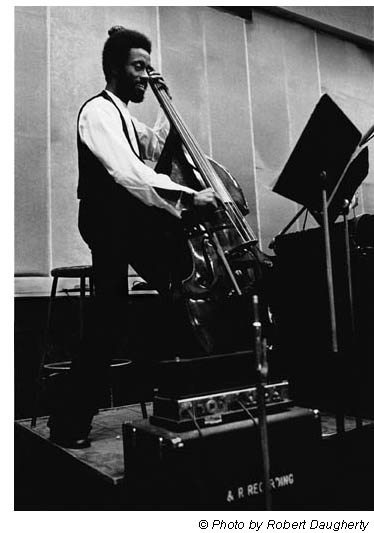
And, the music?  Giuffre plays a lot of tenor saxophone on both dates and one must note the presence of Joe Chambers (pictured left).  By 1965, the drummer (23 at the time) was the first-call for the rhythm section (a seat held on several occasions by Andrew Cyrille and Joe Hunt).  One can tell the young drummer has been listing to his contemporary Tony Williams (2.5 years younger and then with the Miles Davis Quintet). Comprising 6 songs (none shorter than 7 minutes), the 51-minute Quartet set covers a wide swath of territory but the interactions and inventions of the musicians catch the ear. This is often very quiet music, with plenty of space so that each player stands out.  "Cry, Want", at 9:40 the longest track on the CD (and one that the composer has recorded with Bley and Swallow in 1961), finds Giuffre playing blues figures and more on tenor sax over the very active rhythm section and Friedman's stabbing piano lines.  "Quadrangle" stops-and-starts over Phillips' bowed bass with the piano playing percussive lines and Giuffre's clarinet fluttering in and out of the spotlight.  The final performance of the set, "Drive", also stresses interaction and themes with rhythms that move from hard- bop to free to a more mainstream approach.

"Drive" also appears on the Trio date (in fact, 4 of the pieces appear on both CDs), has a very similar structure (in the liner notes, it states that he often wrote out all the parts and that his groups rehearsed intensely) but stands out for the brilliant counterpoint work of Richard Davis.  His bowed works meshes and clashes with the keening tenor sax while his solos are uniformly excellent. He and Chambers create a splendid bed beneath the tenor sax on "Syncopate", pushing and prodding the soloist while he shouts, sputters and wails above them.  After Giuffre's wiggles and wails unaccompanied for his solo on  "Crossroads" (an Ornette Coleman composition from the mid-1950s), Davis takes over with a muscular solo while his partners create splashes of sound.  Chambers starts his short solo loud and works his way down to soft. That sense of quiet permeates the rest of the performance until the rapid-fire restatement of the opening theme.  Though it is a shorter set than the one on the first disk (approx. 36 minutes), the Trio makes the most of this dynamic music.

Jimmy Giuffre would resume a fairly busy recording schedule over the next 3 decades (including reuniting with Messrs. Bley and Swallow several times) and he never really looked back to the music he made in the 40s and 50s (although the Trio did play a number of "pop" standards.)  For many listeners unfamiliar with the man's more "experimental" side, "The Jimmy Giuffre 3 & 4: New York Concerts"are as good a place to start as any.  The music does not sound dated or old-fashioned (the sound restoration is excellent); it can be great fun to hear musicians giving everything they can in the service of such creative music.

The label has no website nor does Jimmy Giuffre but you should be able to find the CDs and more information about the artist on various sites.